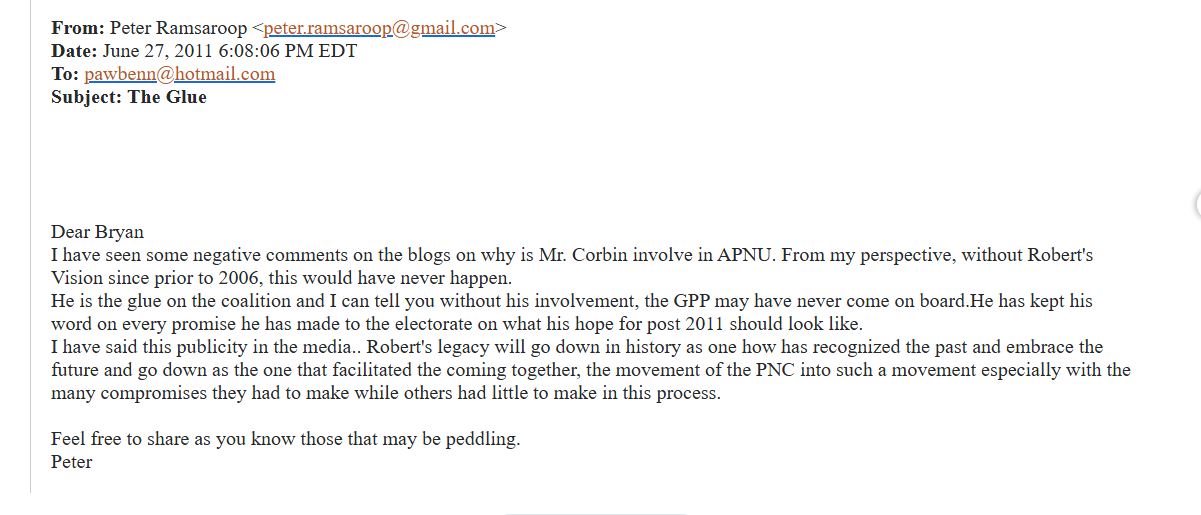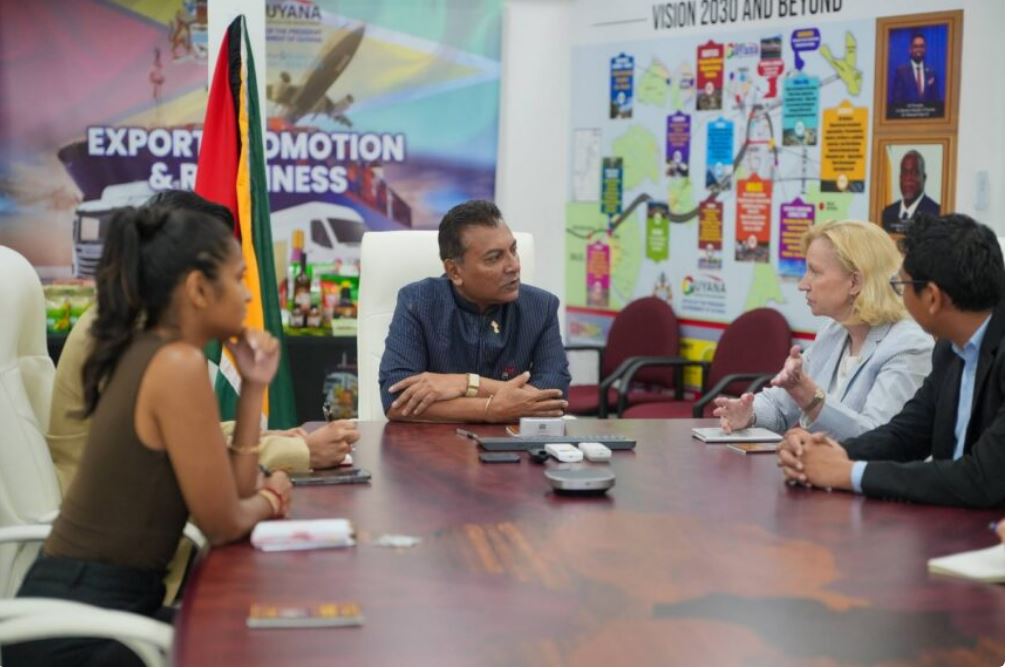

With Sarah Ann Lynch sitting at the table with Peter Ramsaroop, under headline: Business Delegation from US Explores Opportunities, our immediate sentiment was that it could not be good for Guyana, especially the social class that’s now assigned ‘endangered’ status.
Their two names exist in perpetuity, in the country’s political misfortune, synonymous with political death by stabbing…is our opinion.
Ramsaroop has been dubbed the getaway driver. The ominous reference is to the APNU politician, Charrandass, whom he whisked to the airport after Charrandass stabbed the Party in its proverbial heart.
He’s also known for his political ambidexterity, having been a staunch supporter of the PNCR, part of the Coalition whose assassin he extracted to safety.
Here’s how he rolled back when he was two-stepping; writing poetry about the PNCR leader in overt virtue -signaling when he lost residence in the PPP and saw greener grass in the yard next door.
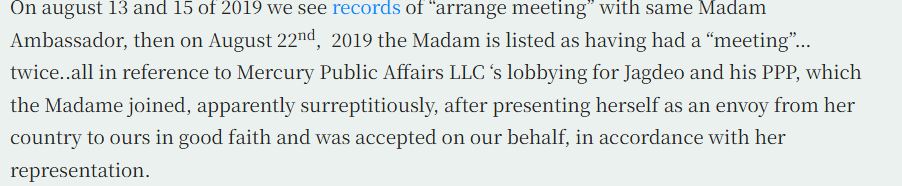
Then there’s Sarah Ann, who is remembered for the shortest pledge of allegiance to serve an entire country, which went asunder after she joined a PPP campaign plane within thirty days of her pledge.
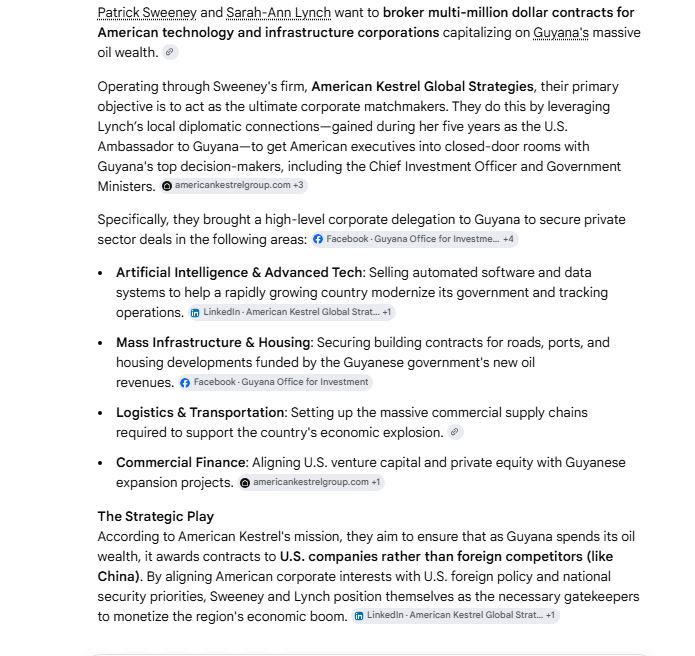
We’d never heard of American Kestrel Global Companies but with Ramsaroop and Lynch plying its ware, due curiosity is a cautionary tale.
Its mission- “efforts to strengthen economic ties and identify new investment opportunities in the country” – is just vague enough for us to associate it with the predatory plundering that’s synonymous with resource- rich, politics -poor, governments. The part of its company statement that espouses “to align commercial development with US strategic policy and priorities Caribbean Area of Responsibility (AOR) ” affirms that its venture is not altruism.
It’s the tricky prioritization of profit over people enabled by a government which does the same, we’re thinking.
There’s enough resource infrastructure concession in Guyana with China’s choke and rob exchange for development, to provide ample example.
The receipt of funds for structural improvement never seems to alleviate the unhoused, the un and underemployed and the cycle of poverty.
We know because there is accounting and operational difference between capital investment and investment in programs for social development.
And GDP is merely a ‘show metric’ that points to growth without distribution. Touting increase in GDP and per capita income only makes sense if there is a correlated reduction in chronic poverty and underemployment.
The rhetorical question is why would the government retain focus on capital investment without simultaneous/parallel investment in programs to reduce chronic poverty and reduce specific demographic un/under employment.
The quick answer, we know, is the appearance of productivity; whose quality is realized only after the product is tested… like craters appearing in newly constructed highways.
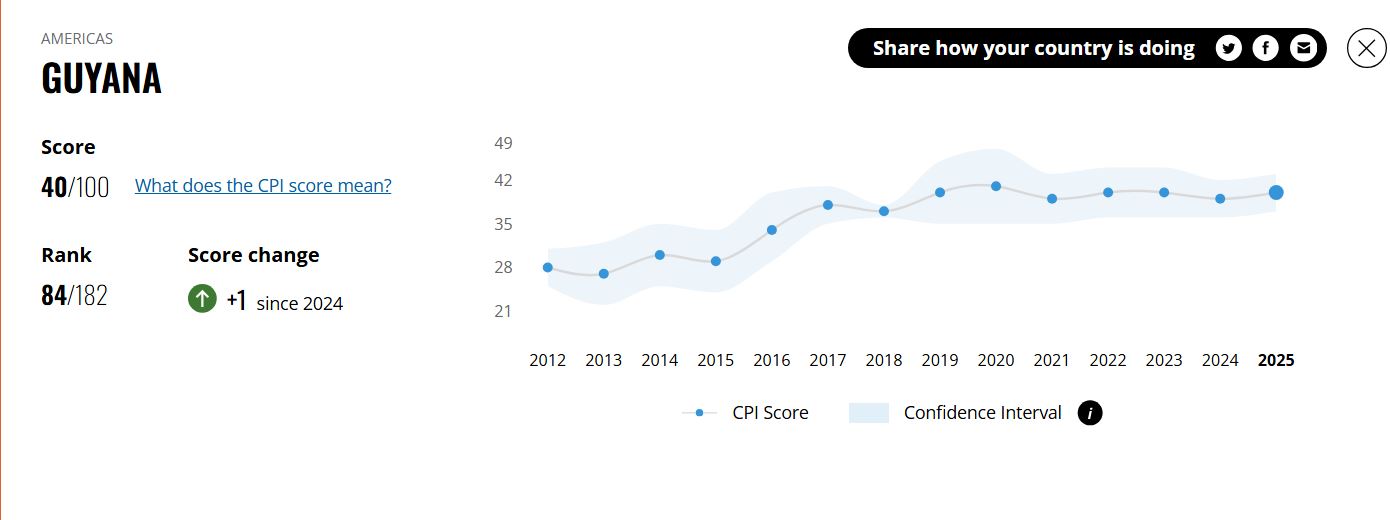
Then there’s the commercial advocacy and security consultancy business. It’s no coincidence that these services are peddled in high volume to countries that sit high on the Corruption Perception Index (CPI).
Guyana has long been a solid member on the lower tier of this metric. With 100 being the best, Guyana’s place at 40 makes it corrupt. And because the index focuses on bribery, misuse of public funds and abuse of public office, 40 makes Guyana very attractive to the peddlers of commercial advocacy and security consultancy.
We’re not saying that the latest contract seekers are making a targeted visit. But we’ve read of strategies like exploiting inside lanes. The familiar face, knowledge of key personnel and their proximity to exclusive/selling access, are the lessons of volumes of text books on this stuff.
Then there’s this fee…the ‘Corruption Premium’… an example of potential spending. Creative accounting by building massive margins to account for cost of doing business is, basically, the kick back mechanism. There is, too, always, the perceived threat, at some level, to cite and prey upon.
We’re not saying that the Madam and her new boss are so engaged. It’s just that, in our opinion, the proximate distance is too short.
Private maritime security, a more robust intelligence system, an AI Robotic Inventory system, might just be what these companies, which assess Guyana’s needs before Guyana does, have foresight to sell as a service to the nation. Accessing the principals to promote all this, is yet, another stream of money. Former officials in the operations theater, who know how the gears turn, may just be available for an income comparable to their pension.
These are all text book watch points for a country that ranks this low on the CPI with an income of hundreds of millions weekly in oil revenue and peddlers of vending and diplomatic heft, soliciting business. And the pictured Team, from American Kestrel Global Companies, doesn’t only make us reflect on those issues.
It reminds of us two other traits of a country like Guyana – Transactional Diplomacy and Regulatory Capture which are exactly what they are called. Transactional Diplomacy – foreign policy deals based on immediate returns and not shared values; Regulatory Capture – when the guardrails guard everyone but the public for which they were intended.
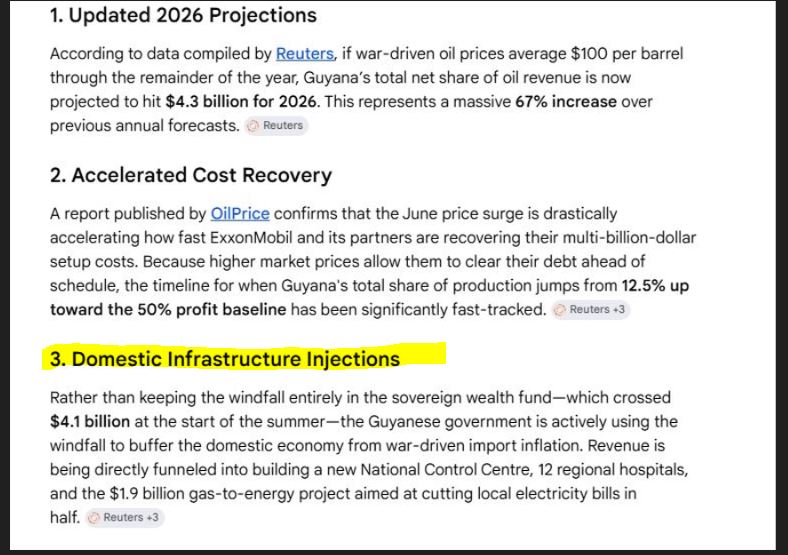
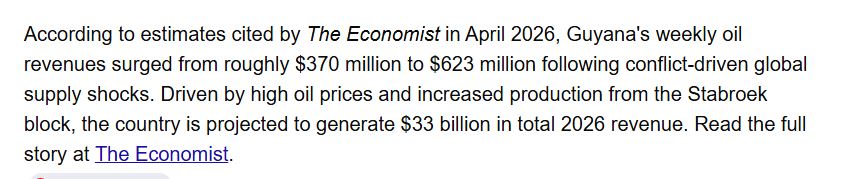
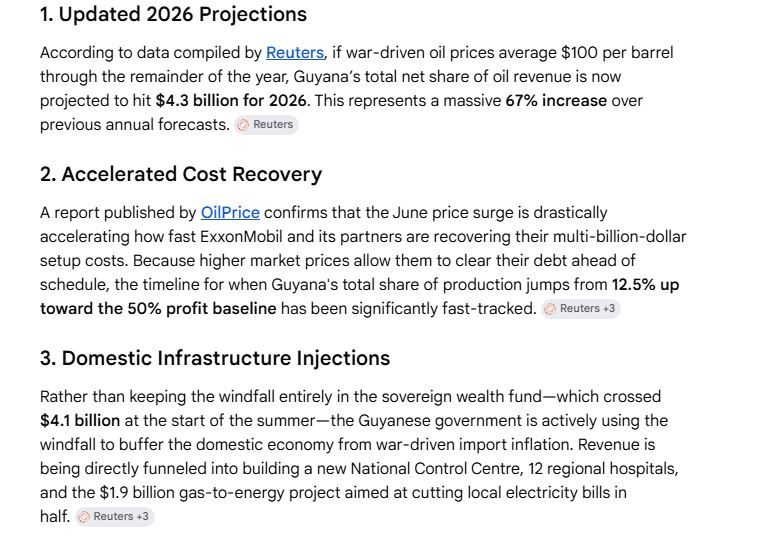
Guyana’s assessment for ‘Care-Taker’ duties, by external entities, forces us to recall its oil windfall since the war with Iran. Since our Accountability discussion, the 623 million weekly has has become exponential. Per economic reports, the government has said the extra billions will be going to more infrastructure. That means- potentially– more contracts to the ‘Unqualified and Friends Network’ which seems to be the fortunate recipient of Guyanese patrimony through the kick-back formula we highlighted – is our opinion.
Maybe that’s why the former Madam and her current employer have bee-lined to Guyana – whose political terrain is her stomping gound- some say.
But, ours is an opinion for a different reason.
There is, from our assessment, the destructive absence of a viable Opposition to watch – dog revenues and implement monitoring systems. Per this prominent Ruling- Party Member, those duties are enshrined in the nation’s Constitution.
We’ve seen how the Norton – led APNU was anathema to good governance -even if it was a competence deficit.
The point here is that the collective Opposition has a duty to serve all citizens, as a constitutional arm of government, by being good counter -stewards of Guyana’s ongoing financial windfall.
Hospitals may be necessary but housing is critical. A National Control Center to monitor electricity does not serve the unhoused. A USD 1.9 billion gas to energy project does not improve chronic poverty or provide light for the poor and unhoused. And these are just the bare essentials of a functioning Opposition that’ s there to do more than simply get elected.
The seating of the collective Opposition, since 2025, has yielded nothing more than the ceremony of them entering Parliament. Paralysis, zero oversight and performative politics, is the equivalent to marking present and collecting a check.
Another flaw in government we learned … ‘presence is mandatory-productivity is optional’.
And, for all the diplomatic intervention that Sarah Ann observed during her tenure as Guyana’s Ambassador, we’d be remiss in thinking that she does not have more than observatory notes on the dynamics and personalities of Guyana’s politicians.
Knowledge of its complex political machinery and its key power brokers, may well have been the selling point to her Kestrel employer.
Her triple threat expertise- regional economics, local political dynamics and hemispheric security strategy, may have peaked with the Guyana experience as fallow training ground.
That said, Guyana is now on the ‘Preferred List’ of companies like American Kestrel Global Companies.
As curious, civic-minded and conscientious stakeholders from a country built on the toil of our nation’s fore parents, achieving Independence under the politics of one of their sons, we have a duty to ensure its wellbeing.
Being active observers of the stewardship of oil patrimony, highlighting counterproductive practices in government’s policy and making public record of it, may be small but it’s one of the beginning critical steps in accountability.
There is no modest endeavor in documentation. Nor is there any wasted effort in publicizing well researched opinion on matters that seem unfavorable to citizens and are insufficiently explained by the ruling and opposing arms of government.
Another thing we learned was the principle of the Immediate Danger of Silence.
And we’ve seen it in practice in Guyana. Where policies are inadequately explained, public malaise and collective morosity transform to apathy. And, the only winners are the governing class.
The antidote to that, we learned, is realizing that silence isn’t neutral, but a slow-burning crisis. To build a system that serves the public rather than politicians, we must lift our voices.
And that’s journalism and the tenets of the profession.