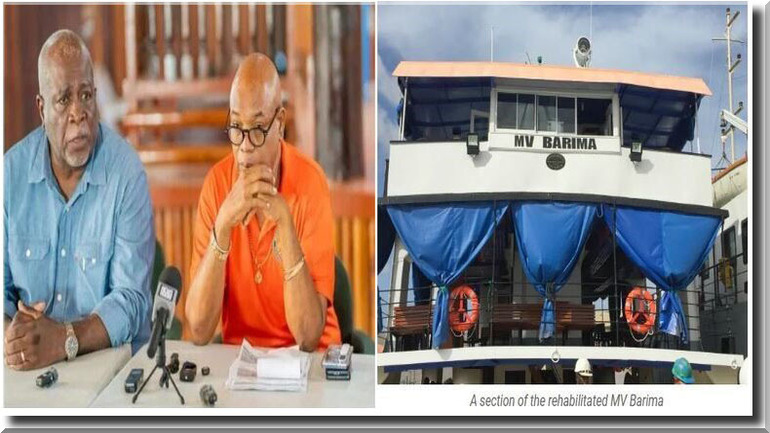

And just like that, public dialogue, mourning in shared civic identity, has swung –officially– to that tribal thing; political finger pointing that shows little reverence for those still to be recovered from the Barima or officially granted status declaration.
We say officially because the blame assignment is published in the National News Organ. This, by definition, represents the opinion of the leading arm of Government and is dispensed for the information of all – with Government’s implied blessing.
We’ll note that it is headlined: Human Rights Association. As an aside, that’s merely their label. It is neither aligned, recognized ,nor assented to by typical National Human Rights Institutions.
The ‘Group’ is registered, in Guyana, as a Civil Society Organization. It does not publicly state who it represents, has no open membership or any declared constituency.
But, tracking its contributions, it has dedication, if not strict devotion, to the current government. This can be traced to its printed opinions which are, invariably, posted in the Government news organ, Chronicle, and favors the PPP.
So, let’s take a look at its submission and the purpose it serves at this time of national mourning.
Its opening salvo of condemnation reveals intent. Mohamed and WIN – mentioned by name and acronym – gives away the political utility of the commentary.
No. It was never about the bereaved or agonizing. It is about a political crisis to be managed. So, this ‘Civic Society member’, in typical civic disorderliness, assumes its position of partisan mouthpiece, rather than an independent watchdog.
The combination of defending the government, deriding its key opponent, all on the government platform, reads like one of those mutual survival pacts. The government trades resources for a manufactured shield and the ‘civic society member’ gets to pretend that it is legit.
In unchecked governments, appendages typically exist to further narratives for governments’ information–laundering and political sanitation–even if it’s one dude and a lap top.
But, moving along.
Outside of the calls for resignation of officials, and the vehement statements prefaced by performative indignation, there’s nothing of rigor offered by the Opposition. And, suggesting that the police should have made a statement by now is just disingenuous.
In Guyana, the police answers to the Minister of Home Affairs, especially on matters of national impact. Statements on multiple deaths and national tragedy would have to be okay-ed d by that Minister.
Instead of harping on the simple and aligning with the din of the usual noise makers, what the seasoned Opposition should be offering is an overall take on the Barima, up to the date of its demise. Comprehensive contribution and edifying information helps with understanding the controversy at hand.
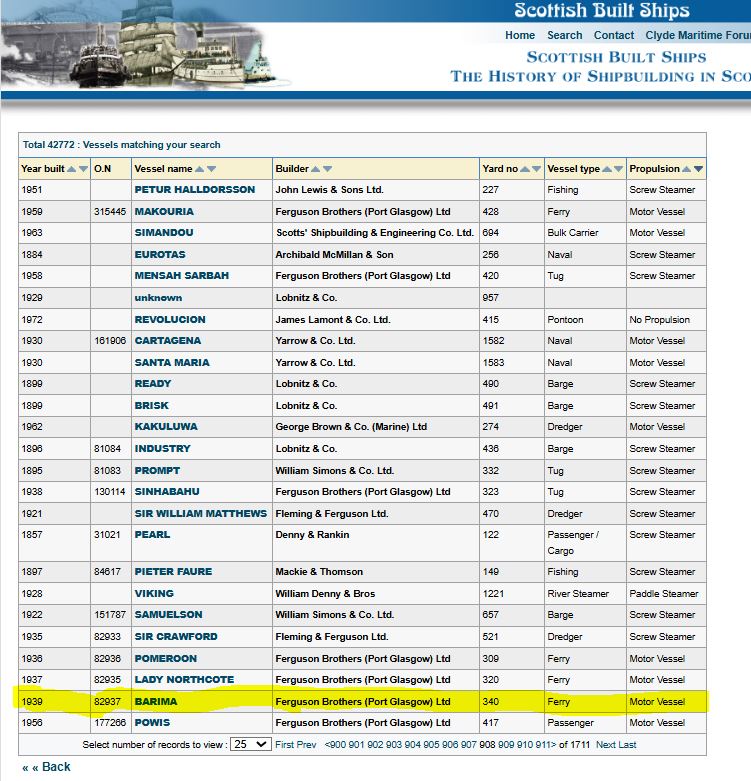
The Motor Vessel (MV) Barima, was a steel passenger and cargo vessel built by Ferguson Brothers in Port Glasgow Scotland, in 1939. It was the 340th vessel constructed by the company, in its specific shipyard.
Vessel maintenance was overseen by British Guiana’s Transport and Harbours Department under the keen and professional eye of Alexander MacDougall. His reputation for procedure ensured a diligence commensurate with and beyond his assignment.
The ferry required a rigid dry docking schedule. Per records, MacDougall regimented its clockwork timetable. This, conceptually, would have buttressed its longevity. Contained corrosion control, stress mitigation, mechanical strain, were all benefits of his rigidity.
And this brings us back to the tragedy, the politicization of the physical state of the vessel and the partisan attempts to blame the APNU Opposition’s tenure, for the ferry finally giving way.
The average lifespan of a commercial steel vessel is typically 25-30 years, per Lloyds Register – the maritime and insurance authority Ferguson Ship Builders would have had to comply with. The Institute of Physics holds the same length of life for a construction similar to the Barima.
Now, on to political responsibility.
By 1953 the MV Barima was 14 years old. Alexander Mac Dougall had retired in 1940, one year after the ferry arrived in British Guiana. .
He was replaced by Colonel Robert V. Teare who assigned MacDougall’s legendary rigidity of maintenance to Captain C. H. Walcott , who shared Mac Dougall’s reputation for diligence.
Teare, however was reportedly a tyrant who used administrative cuts to maintenance budgets in retaliation to the existence of unions. Though this could have impacted the servicing of the Barima, Captain Walcott maintained its scheduled upkeep and its service on its route.
In local politics, 1953 saw Cheddi Jagan win and lose the colony’s first election. He was seated as Chief Local in May 1953 and unseated in October 1953 by the British Government.
Reason? Suspicion of treason.
Jagan won again in 1957, led thru 1964 until Forbes Burnham took leadership in December of 1964, died 1985 . Desmond Hoyte took over in 1985 and demitted office in 1992. David Granger led from 2015 to 2020.
And all of these dates are referenced to highlight the chain of government custody of the Barima Ferry under successive governments and that the vessel was handed over to the PPP in 2020, six years before the Barima sank on July 18th, 2026.
Some topics are uncomfortable to cover because they don’t only go against better judgment. They straddle the decency we were raised to show in times sorrow. Predatorial politicians perceive this as an opening and in their lack of ethics, as an opportunity to score, in anticipation of others acquiescing to moral compunction.
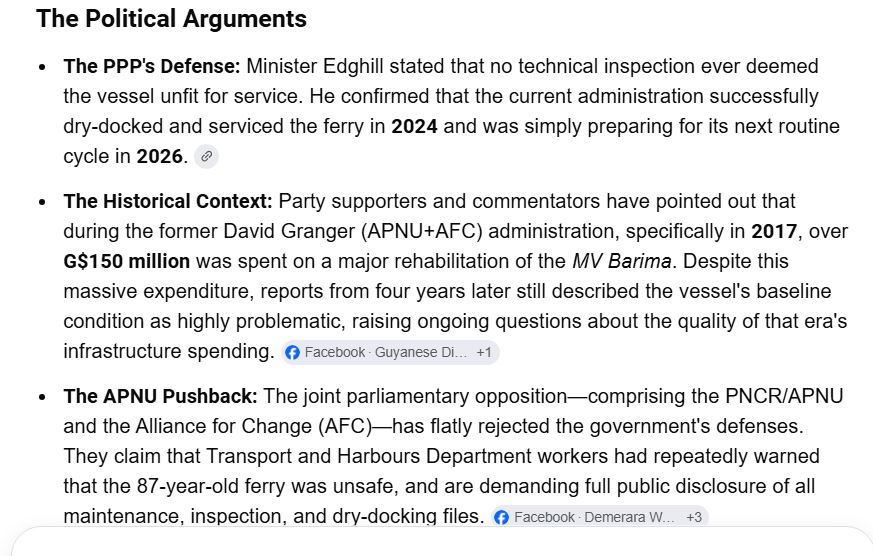
But this is insurmountable tragedy…the kind that causes loss of life through a lack of due diligence. Casting blame after spending 90 million on a vessel four years ago, that was way past river worthiness, is beyond recklessness and incompetence. It’s the kind of public service that does not only demand financial accounting but an accounting of an ideology that would spend so much to repair a vessel that was almost three times its life span, then, on top of that, adding a USD 5million ferry to buttress transport in January of 2026, per this report.
The irreverence of navigating blame at this moment is as critical as assigning it. It’s the tight rope walk between immediate accountability and the preservation of public trust. Already, there is casting of blame. It’s up to the Opposition to make their case with all of the facts that they have now; and not when public confidence would have been hijacked.
You can do several things simultaneously. You can meet this moment with solemnity. You may not have national media. But, you can step past the rage platforms of social media and make a comprehensive delivery via pod/broadcasts.
That will be effective, especially if introduced without the signature noise and appended music– all of which brand any ensuing commentary.
It is an opportunity to course-correct, reshape perception, and redesign outreach.
The nation’s politics is a bitter brew of all that is wrong with it.
This moment of national mourning may just be the right time for introspection; get out of the decibels race; pivot to poise; craft a national message with intent to grieve with a national audience.
Without the distractions, the audience can focus on listening and judge the weight of the words and, by extension, the messenger.
The setting is the prologue to the message. Selecting your messenger will be even more vital to its conveyance. They must come with a character that’s appealing to listeners.
This is a period of national mourning, not caused by mere accident but a profound breach of civic trust.
The message must transform grief into an urgent call for accountability, transparency and systemic reform. It must honor those who stepped onto public transportation confident that the government had secured their safety.
Theirs was not a casual choice. It was reliance on government, whose job it is to protect safety, especially on government owned property. They placed their lives in the hands of the state. The human cost of that trust is now an agonizing reality.
And all this must be delivered striking the right balance of reverence and rebuke, without dishonoring the victims of the disaster with a tone that would be more politics than eulogy.
The government has already stated its case in a torrent of walk backs and finger pointing, sealing it with threats of prosecution for ‘misleading photos‘. Managing public grief with a big stick is a show of insecurity, in the absence of meaningful solutions.
It’s up to you, Opposition, to create a space that encourages heartfelt grief that doesn’t come with a government prescription.
This may just be the moment to show that governing is about empathy, not enforcement. True leadership requires the courage to listen to the people’s pain, rather than policing how they express it. Embracing compassion over coercion could transform this period of grief into general healing and greater trust.
We can go on, but it’s up to you, Opposition, to decide. The realty of death and mourning because of apparent government negligence is an Opposition’s function to highlight.
And if you don’t do it, or you do it ineffectively, you’ll be as much to blame as your governing counterpart.
The Constitution still elects an Opposition which serves the country as a watchdog over the government.
That’s why you’re in office.