
Not that we expected subtlety.
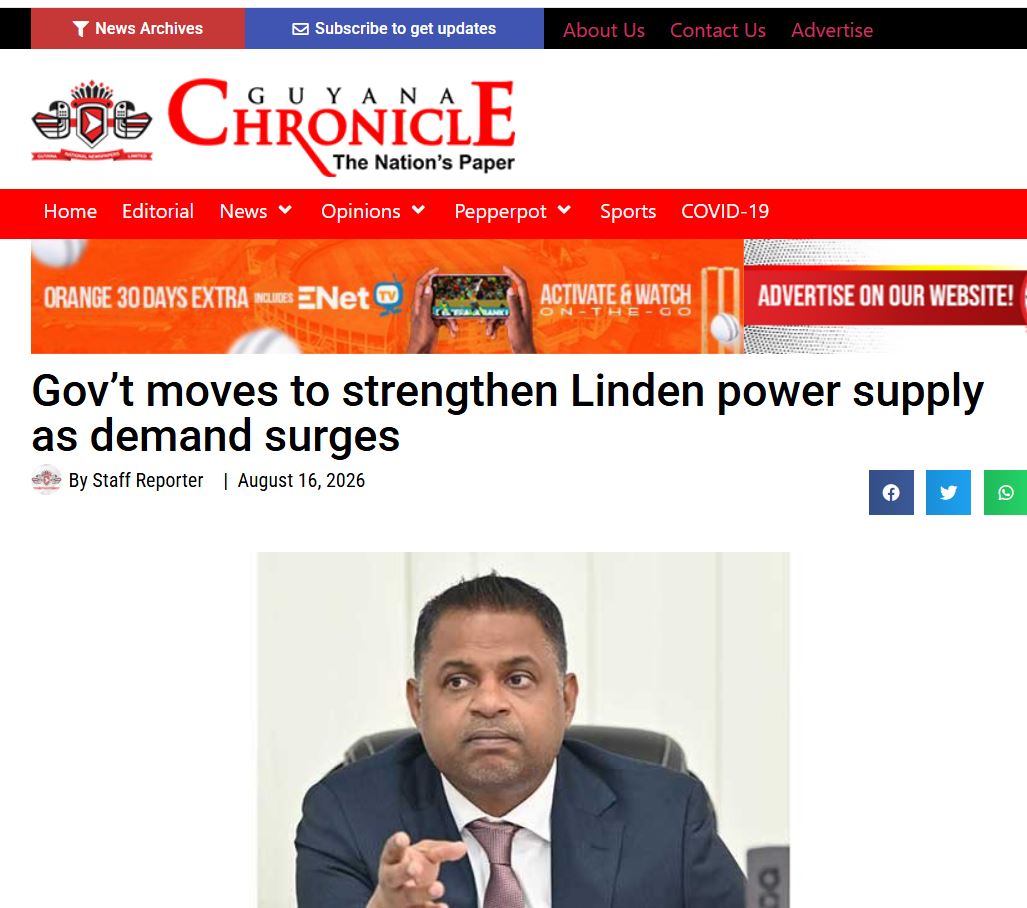
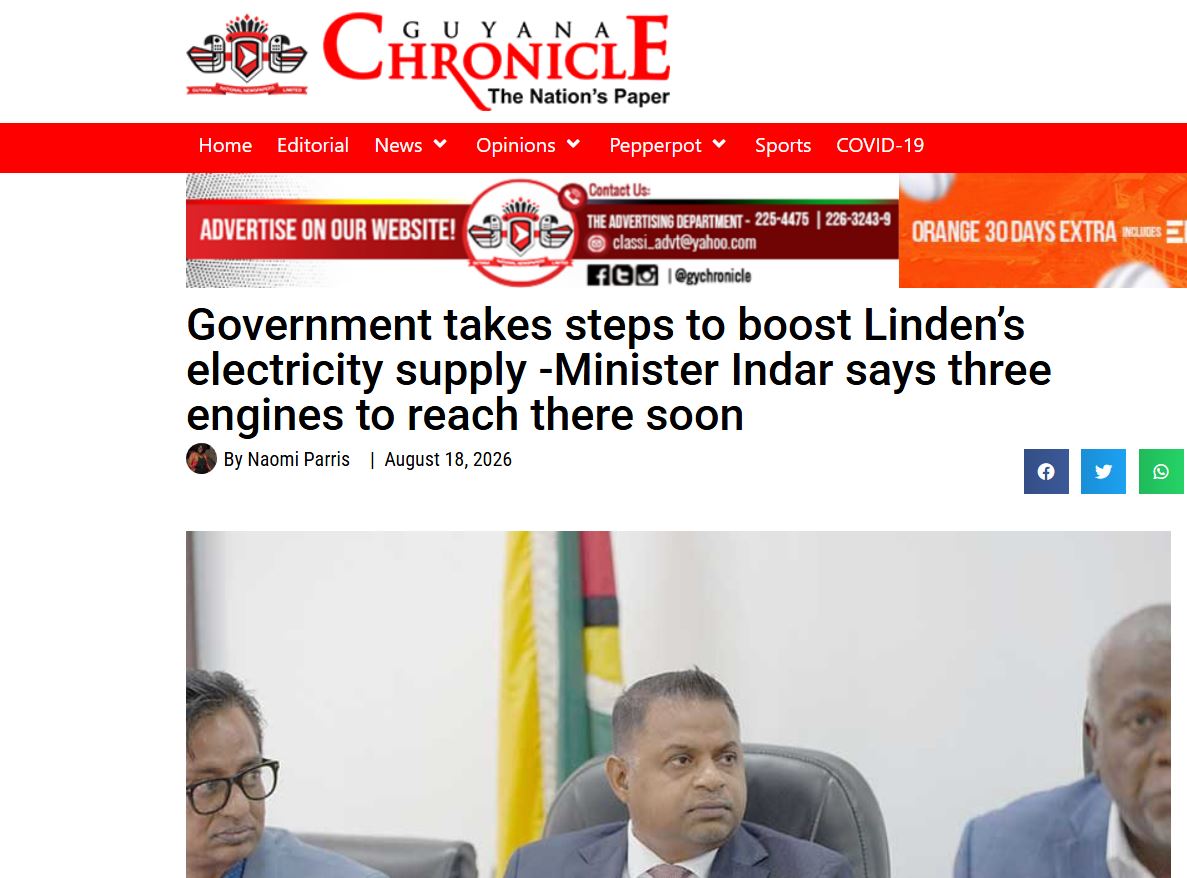
But this publicity campaign to strengthen Linden’s power supply, under a Minister whose portfolio is tied to the recent fatal maritime failure, reads like his sanitizing, more than the provision of the service.
A standstill is definitely not what we’re suggesting.
But if there’s an ongoing investigation, including the pending salvaging of the Barima, attaching greater responsibility to the overseer of the ill-fated ferry sounds like the roulette wheel of government confidence, versus consumer de- prioritization.
We’re not saying there’s an effort to close ranks in the interest of image management, which is critical to government’s standing.
There is, however, the classic government dilemma; internal political preservation versus external public accountability, running interference.
Why Linden we’re wondering, and not for the obvious reason, though name-association is partly why we tend to follow up.
The history of this Government, Linden and Electricity, has not been the delivery of a smooth service order.
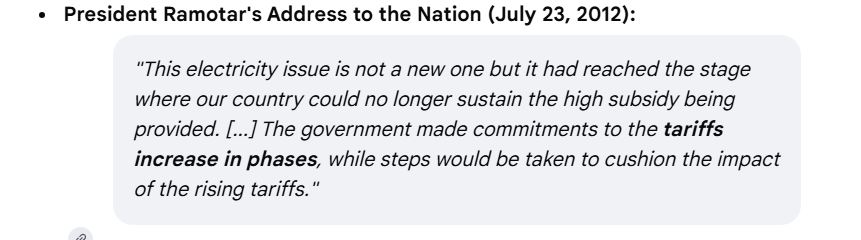
President Ramotar’s 2012 ‘phased’ electricity tariff hike with subsidized $5-15 rates ballooning to $65, was a literal disaster.
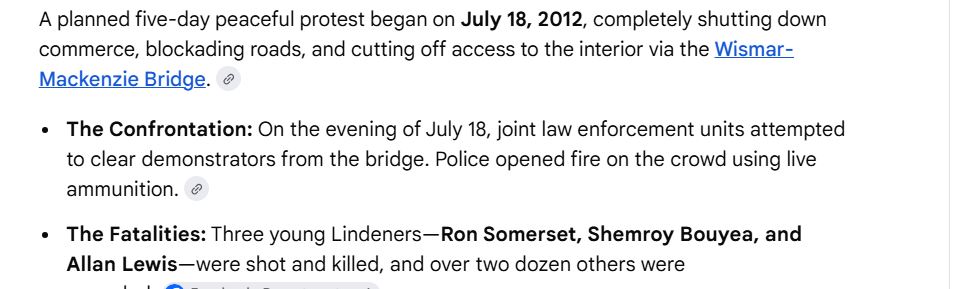
Extended protests and protracted resistance to this price explosion resulted in Linden’s collapse of civil order which caused business and road closures and, sadly, the loss of three lives.
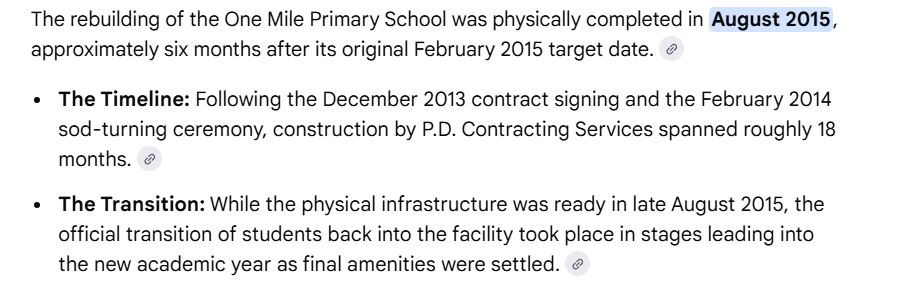
One Mile Primary School, an institution of early learning, and the unhurried response to its casualty during the unrest, was testament to how the government saw the citizens of that area, is the thinking.
That buttoned up that tariff venture; left no question on how irked the government felt by the disturbance in retaliation to a price that could only be unconscionable, if there was no offsetting increase in available income.
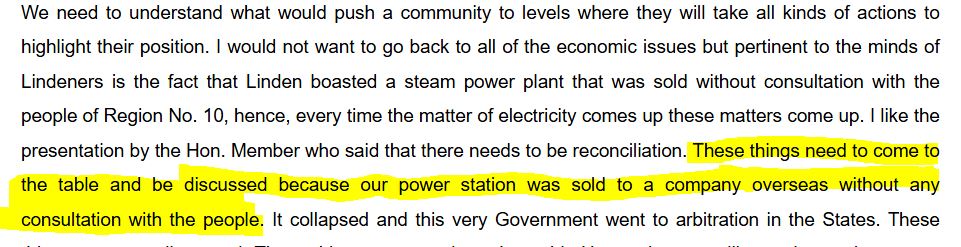
And some of that irritation may lie in the complaint registered in the 59th sitting of the 10th Parliament June 27th 2013.
Linden, then Mckenzie, enjoyed heavily subsidized electricity through a steam power plant that was provided by Demerara Bauxite Company, DEMBA.
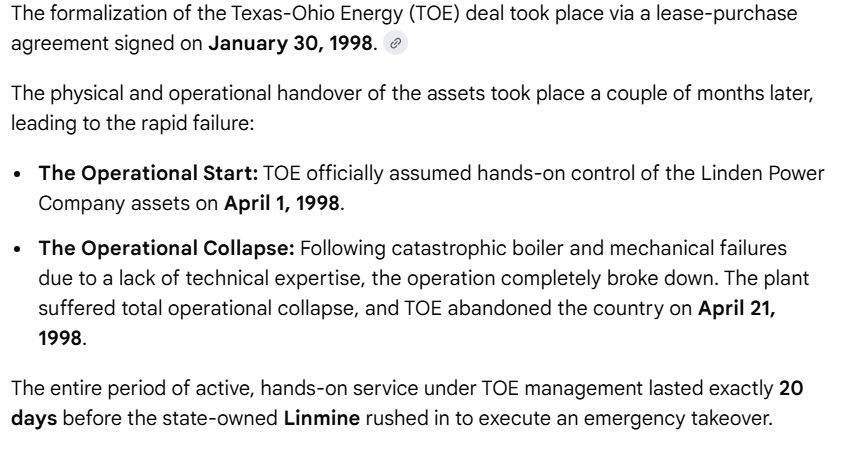
The Janet Jagan Government signed, on January 30 1998, a lease purchase agreement with Texas Ohio for them to take over the steam plant, refurbish and maintain it.
Operations started April 1st 1998. Operations were abandoned 21st 1998. Notably the span of Administration lasted twenty whole days.
Somehow, the PPP’s approach to Linden’s electricity seems to be a hodgepodge of impulse – destination electricity – with mounting costs and repeated mistakes as part of the journey.
And here’s how things went after Janet failed…how the round robin of providers became part of this cascading inefficiency.
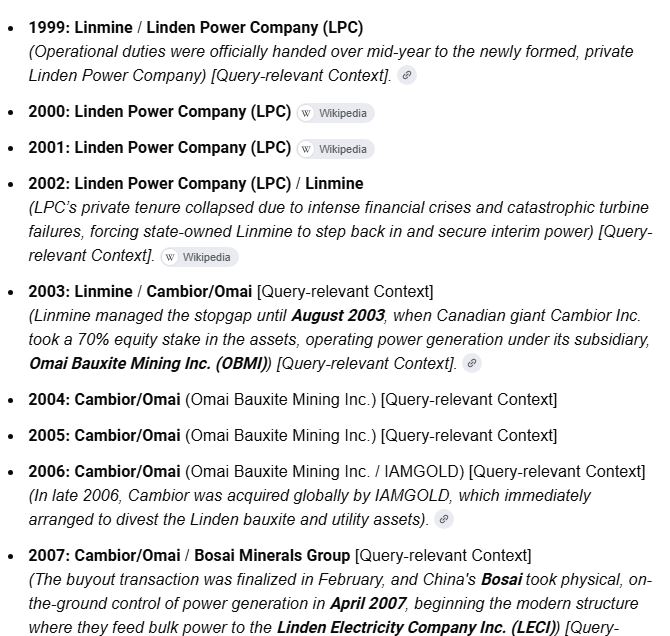
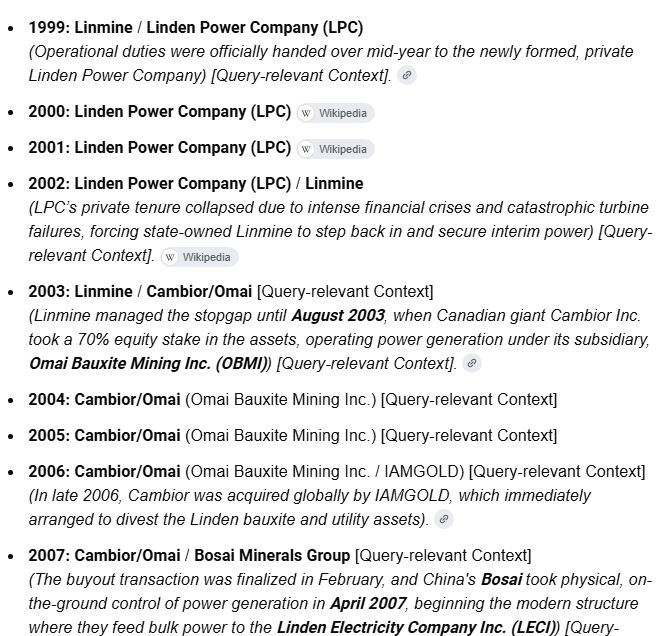
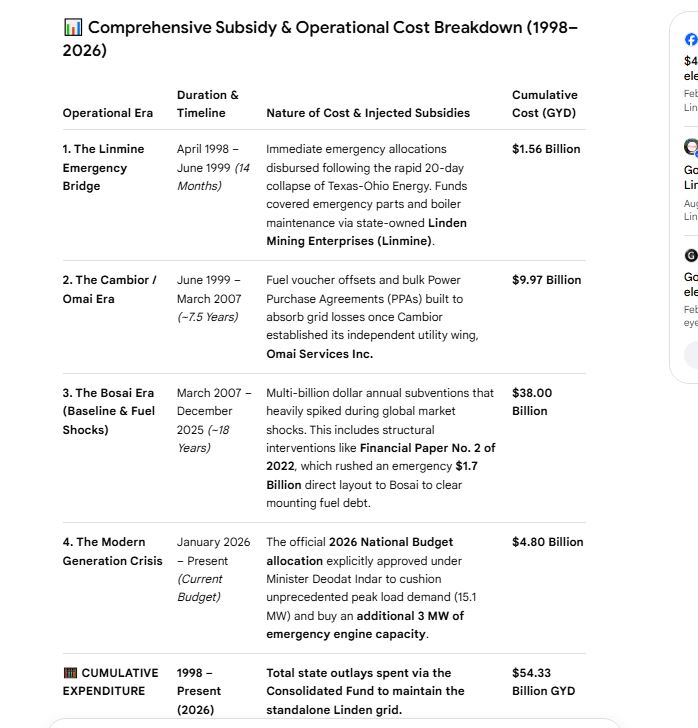
After the Texas Ohio lease failed, Linden Mining Enterprise (Linmine) was forced to provide emergency power from, roughly April 1998 to June 1999 just to keep the lights on.
In 1999 through 2002, the government handed provision over to a private entity called the Linden Power Company (LPC)– plagued by financial crises, exploding turbines, and massive reliability issues.
Because LPC was failing, Linmine had to step back in–2002-2003– to manage power distribution temporarily, while the administration scrambled for a permanent solution.
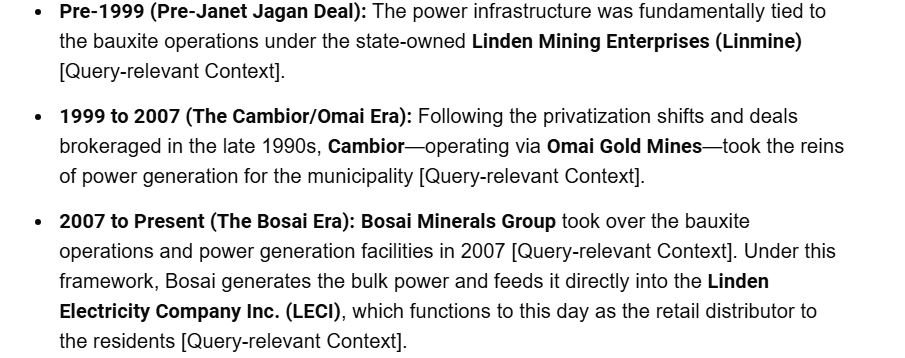
There was a shuffling and kerfuffling within Cambior/Omai which took over power provision from 2003- 2007.
Then Bosai took over in 2007 and remains the retail distributor of power today.
If it sounds convoluted, it’s probably because it is.
We’re just following the operation from Janet’s deal to present, under the same Party’s governance.
And the billions that were expended, seemingly, to create this complicated chain that has always been inadequate, apparently, brings it sharply into focus with Indar as its proposed new overseer.
The existing record of expenditure since Janet’s deal to current is GYD 54.33billion; necessary subsidy included.
Not that we’re comparing.
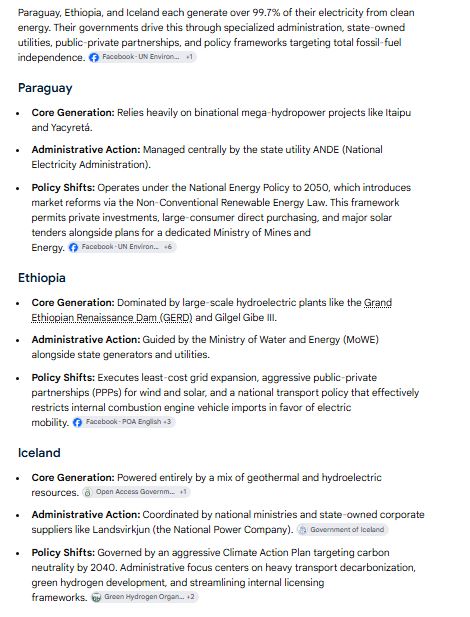
But, the UN’s examples of Ethiopia, Paraguay, and Iceland are the blue print for tapping in to natural resources to alleviate electricity supply and costs.
As a member of this body, Guyana has access to technological assistance to utilize its resources. It pledged, as much, at the CARICOM Energy Month of 2024.
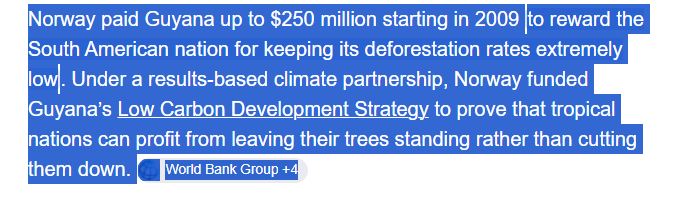
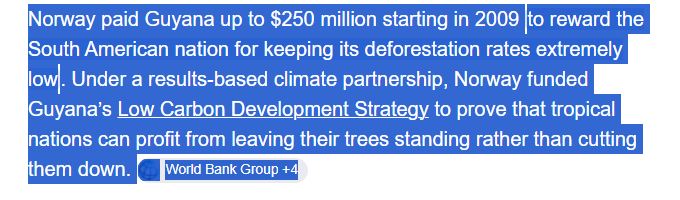
To its credit, it has already embarked upon a Low Carbon Development Strategy to help alleviate electricity costs and is supposed to be functional by 2030.
But, a couple of things.
On the current review on Guyana’s electricity as over performing, we’re skeptics.
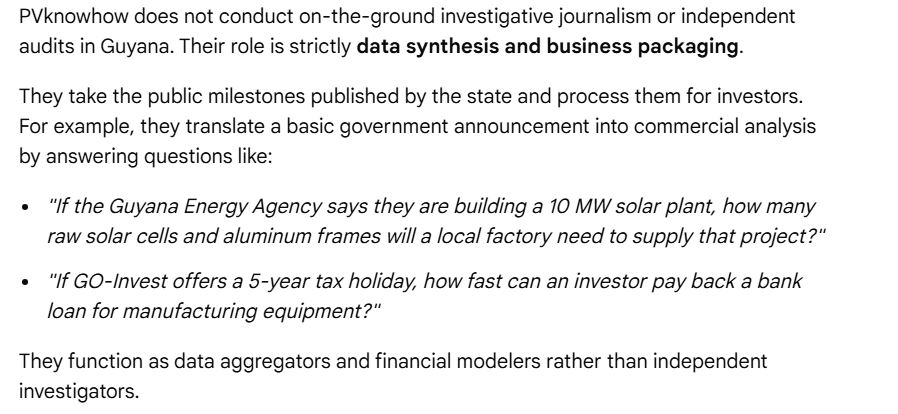
We checked out the reporting source – a PV Know House – and found that its data is not independently calculated but is acquired via government reported statistics.
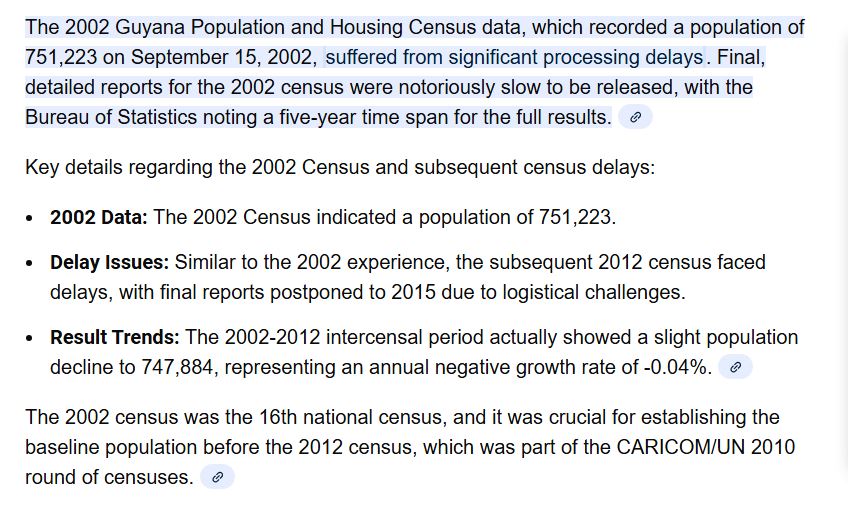
Guyana remains notoriously stale dated on statistics, not the least of which is Census Data – the beating heart of all commerce which lags 3 years behind, as a matter of course.
What we read about Ethiopia, Paraguay and Iceland’s success at natural resource electricity was that their policy is strict and standardized across every administration. Their practice is that of ongoing evaluation and unwavering commitment.
Their incentive is not financial gifting from countries committed to climate change and preservation.
Theirs is a commitment to country, using its natural resources to provide energy in a manner that is responsible for planet preservation. That’s why Guyana was incentivized by Norway.
And this circles back to the tumultuous delivery that was service to Linden and the proposed use of a failed overseer in Indar, who was at the ‘helm’ when the Barima sank.
Pardon the jolt from the high altitude ethics of climate consciousness and planet preservation to, what may have been, localized mismanagement as the operating system.
For all the natural resources in Ethiopia, Paraguay and Iceland, their conversion to a Low Carbon Development Strategy runs on a system of competence.
Comparatively, Guyana’s headline tends to make the case for loud rhetoric versus muted reality.
It’s easy to see why this proposed manager would not be attractive signage for a project that has been a revolving failure under successive PPP governments.
And it questions why the Government would think that ‘moving to strengthen Linden power supply’, while, simultaneously, recycling a failed administrator for critical infrastructure, would go unnoticed, let alone be well received.
The twenty seven years from Janet Jagan’s 1999 contract to current, may have successfully redefined competence to its step-cousin.
Time may have tarnished, relegated, the goal of permanent delivery of electricity to a government gratuity.
It’s the peoples’ duty to hold their supposed promises up to sunlight, map their promises to reality.
Remind them of the 250million they took from Norway to pledge national commitment to low carbon strategy and planet preservation.
And that planet preservation and low carbon strategy begins with the clean and consistent supply of electricity to Linden, under the watchful eye of an unblemished overseer.