Guyana is globally reported as the fastest growing economy in the world …perhaps so fast that it’s forgetting to record Poverty Levels, the Unhoused Crisis, and its minimum wage which leaves many in the masses in comparative poverty…not excluding destitution.
We’ve long been suspicious of the accuracy of Guyana’s economic data but accept that, as a member of international bodies like the International Monetary Fund (IMF) and World Bank there is a fiduciary responsibility for, at least, as close to accurate reporting as they can get away with.
We know economic data is intrinsically related to Census Data and know just as well, that Guyana’s Census reporting remains fashionably late attended by adjustments which boastfully bring up the rear clothed in language like “need for rigorous validation”.
So, for all the boasts about progress and the lofty juxtapositions of Guyana to Dubai – not where the slave labor lives, we hope – we’ll bring, as often as there is change, a look at published economic data conscious of Guyana’s inherent flaws; taking small comfort in the looming presence of external bodies that make the practice of accurate reporting tempered lawlessness.
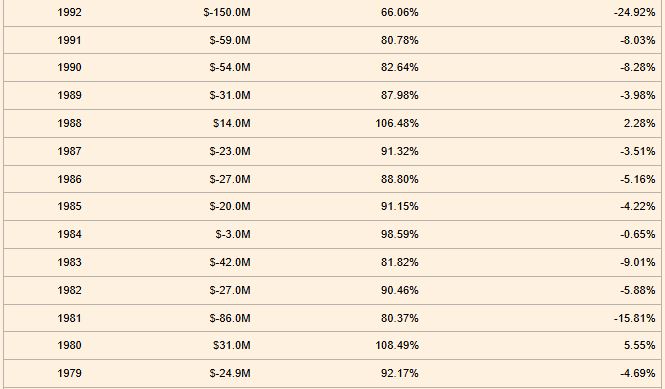
We’ve been careful to capture the Balance of Trade (positive meaning more exports than imports) data between the two major parties from 1979 through 1992 (Sourcehttps://countryeconomy.com/) when the PNC’s, Burnham thru Hoyte would have been succeeded by the PPP.
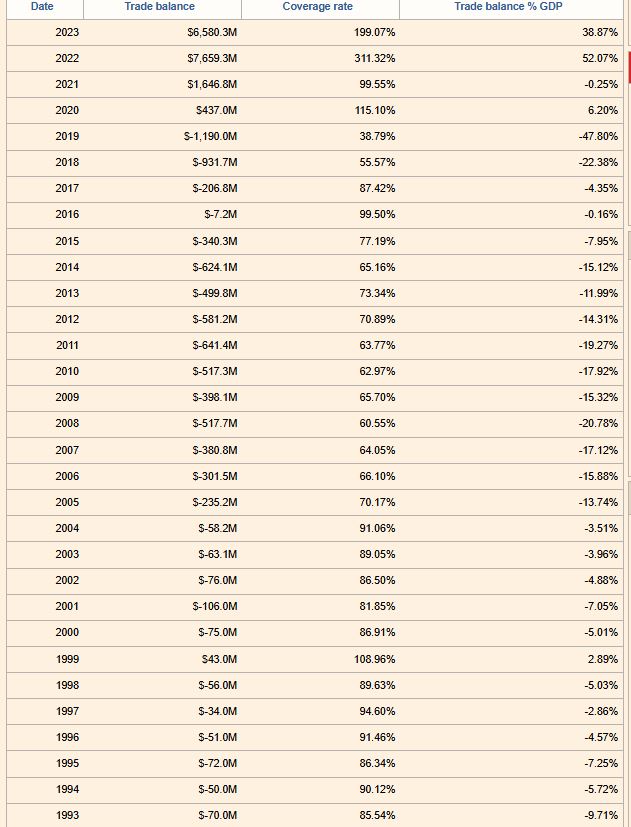
It reflects the handover from PNC to PPP which reigned from 1997 thru 2023, except for 2015 to 2020, when, any economist, especially contemplating Guyana’s lagging reporting, would discount economic and finacial arguments that losses were a result of the politcs of political Party, APNU.
Moreover, it is data which is important to refute the accusation that Burnham is the bane of Guyana’s poverty – past and present and by extrapolation, future –which is the chassis of racialized politics by the PPP.
Jumping in to more current data sourced by Trading Economics, deficits in the national ledger’s GDP annual Growth rate, Balance of trade, Current Account, Current Account to GDP, Govt. Budget, are signs of more spending than earning, more importing than selling. When you spend more than you have, you borrow to cover current debts.
If the lending source is foreign currency then you repay an exchange mark up. And the government budget deficit is typically a result of low revenues versus spending.
Guyana’s economy, like that of every country, has traveled the economic and political terrain of its existence.
It’s harder now to make comparisons between the governing of the two major Parties because political documentation has become the weapon of those who rule, aimed at obliterating the PNC, highlighting its past economic crises which, we acknowledge, befell leadership and the country after an economic hostage taking by lenders, that was the result of refuge sought after poor political decision -making.
What never receives the over-emphasis it warrants, is the shadow economy that was hatched under the PPP during the 1990’s through 2000’s and the Fragile State status it earned under their watch… with attendant drug and weapons trafficking, trafficking in persons, and corruption bonafides that come with those ‘laurels’.
The country now has the fastest growing economy under the jurisdiction of those who took it to its depths.
Elections may have disadvantages but never consequences, as we see it.The Constitution still works and has delivered an elected Leader of the Opposition.
That Leader’s Constitutional duties are to counterbalance the proposals of of the Leading Party whose reputation for bad practices should be the Collective Opposition’s Operations Manual. There is a Natural Resource Fund that was established as a backstop against economic downturns .
Excessive short term stabilization withdrawals and payments for mismanged and unqualified contracts for infrastructure, from the Natural Resource Fund, are draw downs with potential depletion consequences and failure to fulfill a pledge to the people. Intergenerational equity rather than wanton current day use is part of the pledge. Inclusive benefits like like job creation is not for the select. Revenue from oil and other natural resources is patrimony that should be used to create lasting assets for current and future generations.
And this should be the remit of the collective Opposition in executing the duties they were elected for. Like the Leading Party, the collective Opposition, is a cornerstone of governance.
It, too has a fiduciary responsibility to ensure best practices. Competing ideas affirm a democratic parliament, which suggests a pooling of all politcal ideas by all entities elected to parliament for this purpose.
The economy is the nation’s bedrock, it’s lifes blood and the conduit to overall quality of life. As an economy growing at the fastest of its history there are unnumbered pitfalls ahead so it is our duty to keep a critical eye on where that wealth actually goes.
It is the only way to ensure the progress is sustainable and benefits everyone, not just the select few and, particularly, those with with demonstrably questionable qualifications.
The gush of newfound wealth would benefit from a system of diverse stakeholders tasked with overseeing a shared vision to ensure mutual accountability and prevent the concentration of benefits.
And this does not have to happen only under a formal umbrella, this civic wealth creation and participatory governance that is the under tone of the new ‘one Guyana’ slogan.
It is the duty of every Guyanese, politiciand and citizen alike, to ensure those most affected by decisions, particularly the marginalized or vulnerable communities, will neither be bypassed nor sideswiped by those in control of national planning and the nation’s purse strings.
We’re up to the task.